

Pre-assignment
A pre-assignment is a Bulk Bill Assignment of Benefit agreement the patient signs before the service. Reach for it when the patient agrees to assign their Medicare benefit up front (at booking or check-in) before the exact Medicare Benefits Schedule (MBS) item is settled.
New here? The Assignment of Benefit overview explains how pre- and post-assignment differ, and covers signing and retention. This page is about pre-assignment on its own.
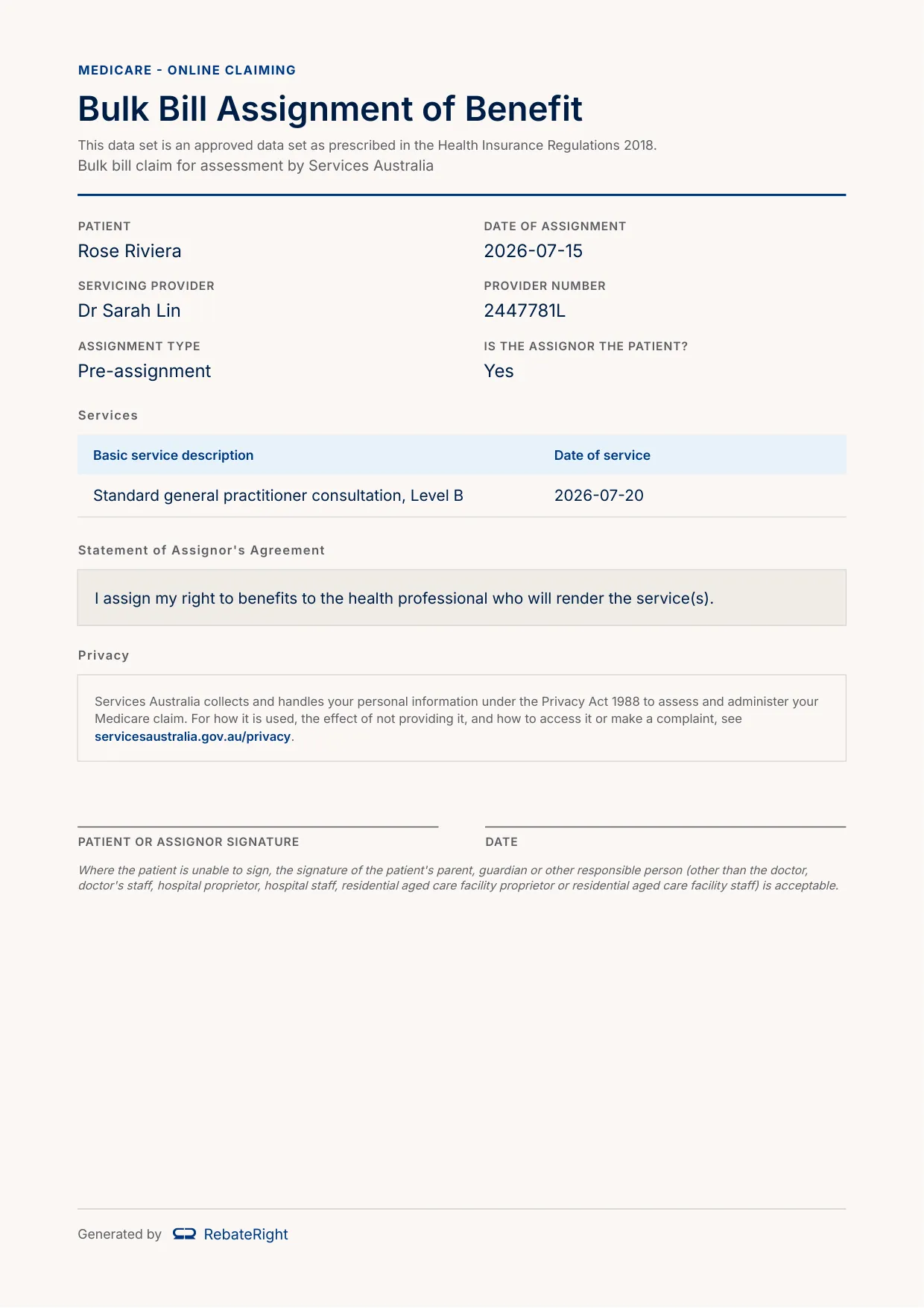
A pre-assignment agreement (general format). Download the PDF.
When to reach for pre-assignment
Pre-assignment fits when the patient agrees before the service is rendered:
- at booking or check-in, before the appointment
- when the exact item is not settled yet, so the agreement names a service description rather than an item number
- for pathology or diagnostic imaging a patient agrees to before attending
If you already hold the claim and the items are known, post-assignment is the simpler path.
What the agreement says
A pre-assignment is written in the future tense: the patient assigns their benefit to the professional who will render the service. It shows:
- the service description you supply, in place of an MBS item number
- the expected date of the service, specimen collection, or imaging procedure
- the assignor’s statement for the service stream (general, pathology, or diagnostic imaging), in the words Services Australia prescribes
You write the description; RebateRight prints it exactly as given. It is not checked against the MBS.
If the service changes
A pre-assignment covers the service the patient agreed to. If what is actually rendered differs materially from that (a different procedure, not just a minor detail), the pre-assignment no longer holds, and you need a fresh assignment for the service performed. Once the item is known, that is usually a post-assignment.
Not for the Child Dental Benefits Schedule
A pre-assignment cannot be used for Child Dental Benefits Schedule (CDBS) claims under the Dental Benefits Act 2008. CDBS keeps its own approved consent form, which must be printed, signed, and offered to the patient to keep.
Signing and keeping it
The patient (or, where they cannot sign, a parent, guardian, or other responsible person) signs and dates each page. An electronic signature is fine. Keep the signed agreement and be able to produce it on request. The overview covers both in full.
For engineers
The request shape, fields, and runnable examples are in the Pre-assignment (PDF) endpoint reference.
Related
- Assignment of Benefit overview: pre vs post, and the shared obligations
- Post-assignment: the after-the-service counterpart